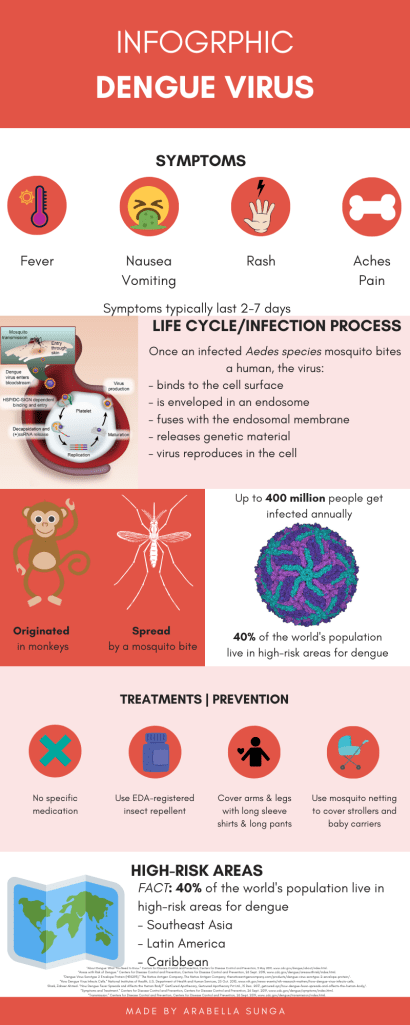
Want to learn more about Dengue virus? Check out my infographic!
Made on Canva
Works Cited
“About Dengue: What You Need to Know.” Centers for Disease Control and Prevention, Centers for Disease Control and Prevention, 3 May 2019, http://www.cdc.gov/dengue/about/index.html.
Guess what?! I recently listened in on a guest speaker presentation by Anusha Shankar… but through a live video call with other schools in the United States. This live presentation was possible through ExploringByTheSeat, which I think is such an awesome experience for students to learn more about the world and should be utilized by all teachers.
Meet Anusha Shankar
Anusha Shankar is an animal ecologist. She is studying how hummingbirds conserve their energy. I learned from Shankar that hummingbirds can die within 2 hours if they do not eat because they exert so much energy in a short amount of time. Hummingbirds get the most amount of energy in sugar water and nectar! What was was interesting to learn about was that hummingbirds enter a certain state called a torpor state where the birds enter a state deeper than sleep to lower their metabolism and conserve energy! The body of the hummingbirds goes cold and shuts down. In Shankar’s research in Ecuador, she was able to see the temperature of the bird with the use of infrared cameras to see energy use of hummingbirds. Hummingbirds are fascinating creatures because they can basically switch from warm-blooded to cold-blooded birds!
Check out this image of a hummingbird in torpor!
Fun facts about hummingbirds!
Shankar also did research on African grass rats to study Seasonal affective disorder (SAD). Those who are more prone to SAD are those who live farther from the equator. These people are more susceptible to this disorder because they do not receive as much light. Light plays a role in how we function and even affects our psychological conditions! Shankar was able to test SAD in rats by conducting experiments where the activity of the rats were studied when put in an environment with lights on and off. One great treatment that Shankar mentioned was having light 15 minutes a day with the help of a device. Who knew how much light made an impact on our emotions! I certainly did not realize how big of an impact light influences our emotions.
There is so much research being done about so many different things! Like Anusha Shankar, I would want to participate in differing research programs to learn about many things and know more about my own interests. I encourage you to put yourself out there and learn more about science!
Each day I step into AP Biology class, I learn so many bizarre things that are going on in the world and all around us. Change.I consistently see and hear about change and advancements. From designer babies to a small change in our DNA sequence, we are now able to do things to change our appearances or even find a cure to diseases just by the current biotechnological advancements.
Have you heard about gene therapy? Gene therapy is the introduction of a normal gene into a patient, usually to treat diseases caused by a single defective gene. Scientists are treating patients with diseases by adding a new allele in strands of RNA which are placed in a retroviral vector. The vector is then inserted in somatic cells, such as bone marrow cells, so the normal allele is inserted in chromosomes and is reproduced. One genetic disease gene therapy treats is severe combined immunodeficiency (SCID). SCID patients show a very weak immune system, which makes them susceptible to all kinds of illnesses. Since bone marrow reproduces throughout our entire lives, includes stem cells, and even produces our blood and immune system cells, bone marrow cells are a prime candidate to help SCID patients. Gene therapy has been used to treat Leber’s congenital amaurosis (LCA), which is a retinal degenerative disease that causes vision loss, a blood disorder, and even a degenerative disease of the nervous system.
Learn more about how gene therapy works!
One of the awesome things that AP Biology course equips the students are the several guest speakers that come in and share their insight about biology. Recently, Mana Anvar, an MS student at UCSF, shared her story working in UCSF’s Baraban Lab. There she studied pediatric epilepsy on zebrafish models in order to gain more understanding and research on Dravet Syndrome. One big connection that I learned in class that she mentioned is CRISPR-Cas9, which essentially edits a genetic sequence. In this lab, she was able to use CRISPR-Cas9 to edit or remove the gene that causes Dravet Syndome in zebrafish to observe seizure activity. She performed several tasks such as genotyping, sequencing, cannabinoid drug screening, and tracking. To experiment and understand how the drug could essentially help individuals with Dravet Syndrome, she analyzed and tracked the distance, movement, and velocity of the zebrafish treated with the drug. Anvar not only explained her work relating to biology research, but she also inspired me to pursue the subject because biology is interdisciplinary. Biology never fails to amaze me.
I found this super helpful when learning about CRISPR-Cas9!Can you believe researchers are editing genes using CRISPR-Cas9 on these small zebrafish?!
All of these advancements are pretty awesome to think and learn about, but of course, there are ethical concerns. We must think about the extent to which we use these technologies and gene editing. This is a great transition into our class conversation on bioethics! Keep that in mind and as the Amoeba Sisters say, stay curious ✌️.
Ahh, gene therapy reminds me of my symposium about the genetic disorder Adenosine deaminase deficiency that causes severe combined immunodeficiency (SCID). Gene therapy is a revolutionary advancement that can help treat several disorders usually caused by a single defective gene. Check out this presentation that I made with Chloe to learn about recent technological advancements and how gene therapy works:
I know, I know, that is a really random quote, but I was thinking about dreams and that song was on my mind. I was thinking about dreams because I watched Diana Nyad’s TedTalk about accomplishing her lifetime dream of swimming from Cuba to Florida and her epic journey! What surprised me is that she did that at the age of 64! Her story is extremely inspiring because through her many attempts, she never gave up. She was persistent and determined to cross the finish line. I believe we can all take a many lessons from her. Age is not a number that determines if we can accomplish our dreams and goals. We say that we are too old to do something we have always wanted to achieve. As a result, we live our lives regretting not ever accomplishing our ambitions.
Between you and me, just last week I said that “I’m too old to learn how to ice skate” (Remember: this is just between you and me 🤐). Is that really true though? Is there really a certain age that tells people what you can and can’t do? Nyad’s TedTalk really inspired me to do not only the small things I want to accomplish in life, but also my big ambitions. I learned to not let any factors, such as age, fear, or doubts, get in the way of my dreams.
The photo on the left is me attempting to ice skate before 2019 ended.You can say that I am improving.
When Nyad said, “Isn’t life about the journey, not really the destination?”, I thought about how what we make of our short lives determines who we become. Challenging yourself to becoming a better overall person is how we can live our lives to the fullest. When I was watching the video, I thought to myself, what is life if we live in complete fear? Nyad was swimming in complete darkness and she knew there were marine animals that could harm her, but she did not let that get in the way of her dream. Living and complying with our fears and staying in our comfortable bubble prevents us from really living. Remember that life is what you make of it and you have the power to choose what you do with this life. Through Diana Nyad’s journey, she had the help of a team to guide and motivate her until the end. In our path to pursuing our dreams, we all need a support system to help push us to our goals.
I want to pursue medicine to help people in third-world countries that are in need of free healthcare. Growing up, I knew I wanted to continue my mother’s legacy of performing medical missions in the Philippines and beyond. I saw how the majority of the people living in the Philippines were impoverished and I could not ignore this issue. I believe that with time and my diligence, I will be able to help these people who cannot afford simple check-ups at clinics. Each person in my life has been supportive of my dream and never have I once doubted myself about this. At a young age, my mother caught me emulating medical diagrams from her textbooks. I am still the same curious and determined girl that wants to make a difference in the world through medicine.
Hi guys! I am back from winter break and I feel extremely ready to start a new semester of AP Biology! The last break replenished my mind for another fun semester of learning!
Looking back at semester 1, I learned so much about biology! From learning about ecology to genetic disorders, I was fascinated by the process and study of life! My favorite season was the Characteristics of Life and Genetics unit. Within these seasons, I learned about ecology, properties of water, macromolecules, and different genetics disorders. I especially loved being able to integrate technology and enhance my technological skills in my education. One of my highlights was the Vortex Swim project because I was able to research about an itching question that connected to the unit. Understanding biology at the molecular level and seeing connections to several units has been intriguing to me so far.
AP Biology taught me a lot about myself and my teammates. I learned much about my own learning styles, time management, stress management, and motivation. Since AP Biology is an everyday course, I was able to conquer my challenge of procrastination and began focusing on excelling in time management. As a result, I was able to spend more time on my other interests, friends, and family. I also discovered that I learned best by consistently reviewing physical, handwritten notes. In just one semester, AP Biology taught me how to become a better and more efficient student. In the classroom, I loved learning and listening to lectures because Ms. Girard always had a fun way of teaching and conveying the lessons. The energy in the room from my peers and teachers motivated me to continue putting hard work in studying, assignments, and projects. Now that semester two is rolling in, I am so excited to learn about biotechnology!
During my first semester, I went to the Aquarium of the Bay at Pier 39 in San Francisco. Below are some photos I took that connected to what we learned in my first semester of AP Biology!
One of my favorite ongoing project of this college-level course is my digital site! I love connecting with other people and sharing my projects/investigations worldwide. When I first started this website, I had no idea how to update the site. Through research, public forums, and persistence, I was able to understand not only how to work WordPress, but also enhance my site to intrigue other people. Although I have faced several technological setbacks, I was able to learn more about finding solutions and reaching out to other people for help. This upcoming semester, I am so excited to post more about my investigations, labs, and blog posts to inspire other young and amazing scientists around the world. So far, I everything that I have learned, such as technology and learning skills, will always be in my back pocket for for future use.
Let me ask you this question: Where can you find DNA? I bet you’re thinking that DNA is found in all living things, right? This is true, but you may not even realize that DNA is also in small things, like cells and fruits. DNA is found in all living things to grow and develop. My AP Biology teammate, Noosha, and I created a video where we extracted DNA from a strawberry! At first, we had some trouble efficiently getting the DNA, but eventually found out what went wrong. Check out what happened in our video! Overall, I really recommend doing this experiment and learning something new, especially with a buddy. I found a new experiment I can do with my little brother! If you try it out, let me know in the comments below!
Ah yes, genetics. One of my favorite topics! Genes are a unit of heredity which we get from our parents and expresses our characteristics! Your genes determine things as noticeable as your height or the color of your eyes all the way to things you do not even realize, like your health.
To start off our genetics unit, my AP Biology class watched Cracking Your Genetic Code. The documentary discussed the ethics and the pros and cons of easily accessing your genetic information. The step to finding and encoding our genetic code is extremely revolutionary, but all good things have downsides. Understanding and knowing own genetic codes enable us to also determine the causes of health issues in one’s body or predict certain illnesses.
*Warning: SPOILERS ahead*
Within the documentary, there were real life examples of the benefits of encoding our genes. One example was on twins who wished they had their genes encoded earlier since they experienced severe cerebral palsy symptoms later in life. Determining our genetic codes earlier may sound revolutionary, but the documentary talked about how knowing and accessing this information earlier may disrupt life. Knowing information about increased risks of illnesses at an early age invades a child’s privacy. For instance, if parents were to access their child’s genetic information immediately after they were born, the parents may prevent their child from certain activities. The issue is that this information may save a life or interfere with one’s life.
As accessibility and cost of determining genetic information increases, privacy decreases. As our world continues to advance, we may not even need our social security numbers since our genetic information may take over to determine our identities. The documentary brought up a good point that if our information becomes more openly discussed, we may narrow our vision by only looking at genetics. People may start to question the genetics of other individuals, such as their partners to understand how their children could potentially be affected by their genes. Additionally, eugenics and designer babies will begin to rise in popularity if people continue to look solely at genetics. This is unethical because this may decrease genetic diversity, which is important to evolution.
Interested? Watch this preview of Cracking Your Genetic Code.
Personally, I don’t know if I want to know my genetic information.
What do you think? Would you want to know your genetic information? Leave a comment below.
What is meiosis? Meiosis is categorized in two stages of division. Meiosis is a type of cell division that divides a parent diploid cell and results in four reproductive, haploid cells. The four haploid cells contain half of the chromosomes of the parent cell. My AP Biology teammate, Noosha Steward, and I created a video about meiosis in plant cells. The video covers and shows each phase of meiosis and explains the process of crossing over, which is the reason for genetic variation! Learn more about meiosis and check out our video!
I enjoyed the filmmaking and editing process with my partner. I feel like me and Noosha worked really well together and developed an awesome bond through this project. I love making stop motions for videos. Although the process was time consuming and laborious, I love seeing all the hard work come to life! I learned new features in the app, Stop Motion Studio, such as the self-timer and the grid and onion skin controls. In the past, I have created stop motion clips and manually took pictures, but I have never used the timing feature, which takes a picture when you set the timer, and the onion skin control to see and change the opacity of the previous image. I am glad I learned these useful features! Overall, I loved how our video turned out and I hope you do too. Leave a comment below!
Making a stop motion video? Here are some quick tips:
Use a self-timer!
Use the grid and onion skim controls
Try to be in one place so the lighting does not change
Purpose: The purpose of the chromatography experiment is to separate and identify individual pigments of green colored leaves and non-green colored leaves.
Background: Photosynthesis is the process by which photoautotrophs convert solar energy into sugars. Photosynthesis occurs in the chloroplasts of organisms and is usually green due to chlorophyll, which is present in all photosynthetic organisms. Pigments within plants absorb light energy to start the process of photosynthesis. Chromatography separates and identifies the pigments within plant cells on chromatography paper. The solubility of the solute and the diffusion of the solute determines the rate of migration of the pigment. The Relative Mobility Factor (Rf) is determined by the distance of the spots of pigment on the chromatography paper traveled divided by the distance the solvent traveled. The pigment can be determined by comparing the Rf factor of one pigment from the lab to Rf values from the same pigment under constant conditions.
Hypotheses: If chromatography was conducted on a green and non-green leaf to determine the pigments, then the non-green leaf will show a larger range of colored pigments, such as anthocyanins, along with green on the chromatography paper since there are more different colored pigments and less chlorophyll present within non-green leaves rather than green leaves.
Data:
Green Leaf
Pigment
Green
Dunknown (Distance solute traveled) (cm)
7.1
Dsolvent (Distance solvent traveled) (cm)
7.3
Rf (Relative Mobility Factor)
0.97
Non-Green Leaf
Pigment
Light Red
Dunknown (Distance solute traveled) (cm)
7.6
Dsolvent (Distance solvent traveled) (cm)
7.9
Rf (Relative Mobility Factor)
0.96
Questions:
1. What is the basic importance of chromatography?
Chromatography separates different pigments within a mixture sample on chromatography paper to identify the substances with Rf values.
2. What factors allow chromatography to happen?
Capillary action occurs when the solvent moves up the chromatography paper due to absorption of the chromatography paper, adhesion, and cohesion. The solvent is attracted to like molecules (cohesion), but is also attracted to other substances, such as the paper (adhesion). As capillary action occurs, the solute travels with the solvent. The solubility of the solute and diffusion determines the rate of which the solute travels up the chromatography paper from an area of high concentration to an area of low concentration.
3. What purpose does the chromatography paper have in this experiment?
The chromatography paper absorbs the solvent and serves as a medium that the solute may move up on during capillary action with the solvent. As capillary action occurs, pigments may travel up along with the solvent, showing the underlying and various pigments.
4. What is the purpose of the solvent?
The solvent performs capillary action on the chromatography paper and aides the solute’s movement up the chromatography paper as the solvent moves up the paper. The solute will then show the various pigments of the leaves.
5. What does Rf value stand for?
The Rf value is the Relative Mobility Factor Value that represents a ratio of the distance a substance travels to the distance the solvent travels.
6. How do you think the Rf value is useful to scientists?
The Rf value helps scientists identify pigments in different leaves by comparing different pigments from leaves to standard Rf values for certain pigments since Rf values for certain pigments are constant.
7. What does Dunknown signify?
Dunknown is the distance solute traveled.
8. What does Dsolvent signify?
Dsolvent is the distance solute traveled.
9. How many pigments were you able to identify from the GREEN leaf chromatogram? Include a picture.
Only one pigment, green, was identifiable from the green leaf chromatogram and traveled at the same rate as the acetone solvent.
10. How did a GREEN leaf chromatogram compare to a NON-GREEN leaf chromatogram? Include a picture.
In this experiment, the green leaf chromatogram (right) had only had green pigments, while the non-green leaf chromatogram (left) had a light red pigment.
11. What else did you find out about pigments and photosynthesis?
Photosynthesis occurs within the chloroplast of several photosynthetic organisms, such as plants and algae. I learned that chlorophyll was the main factor that produces the green pigment within many plants. Additionally, I learned that all photosynthetic organisms contain chlorophyll in order to do photosynthesis, but some different colored plants may have smaller contents of chlorophyll.
12. What is one more question you still have?
Do carnivorous plants, such as the venus fly trap, still go through photosynthesis? If so, why do carnivorous plants need to do photosynthesis and consume insects?


 Arabella Krystienne's AP Biology Blog