Body Systems

Human Body Systems

Ever since I was a young girl, I have always been crazy about the human body and the amazing things the body could do. At a young age, I noticed how the body could heal scrapes and wounds that I got from play structures. In elementary school, I fractured my arm during fencing practice. At the doctor’s office, I was wondering why I only came out with a cast. With time, my body healed itself and I was astonished at what the human body could do. In Season 10 about Kingdom Animalia, I learned so much about the different body systems and I want to share the content with you. Hopefully, I can teach more curious children about our awesome body systems through this book.


Want to study and learn more about the human body systems? Check out this free resource that provides an (introductory) infographic, an activity/article, and a graphic organizer for EACH body system! (BTW, don’t get carried away… I ended up staying on this resource for about an hour 😬!)

https://www.carolina.com/teacher-resources/Interactive/human-body-systems/tr40161.tr

Also, check out these video about the human body systems! All your systems work hard together in harmony to in order to keep you healthy, safe, and protected. For this reason, let’s celebrate our bodies!

Video published by National Geographic
Video published by the Amoeba Sisters

Arabella’s star review on these resources:

Rating: 5 out of 5.

Fetal Pig

Growing up, I heard stories from my mother about how she was able to dissect cats, frogs, and baby sharks in medical school! When I heard about the fetal pig dissection in AP Biology, I was so excited. Although I was not able to get full hands-on experience, Mrs. Girard still showed us the dissection via Zoom!

Image taken by Mrs. Girard

Prior to watching the fetal pig dissection, I never realized how similar pigs are to humans. I found this idea very fascinating when we were going through the pig’s anatomy. Also, I was surprised to see that diagrams online look extremely similar to the actual body!

Images taken by Mrs. Girard

The image on the left is the fetal pig’s heart. Blood flows through the entire body, carrying different products such as oxygen, carbon dioxide, and hormones! There are several blood vessels and structures that is part of the circulatory system such as the superior and inferior vena cava, right atrium, tricuspid valve, right ventricle, pulmonary semilunar valve, pulmonary trunk, pulmonary arteries, left atrium, pulmonary veins, left atrium, mitral valve, left ventricle, aortic semilunar valve, and the aorta. The heart also has 4 chambers, which makes the heart so efficient because the several chambers don’t allow oxygenated and deoxygenated blood to mix! Around the heart is the pericardium, which is a membrane that is responsible for holding the heart in place, prevents the heart from getting too big in size, serves as a layer of protection from diseases or infections, and lubricates heart muscles.

We also covered several other body systems, such as the digestive, respiratory, and reproduction systems; however, I thought the circulatory system was the most fascinating. When the heart was cut in half, I was so surprised to see the right and left ventricles because of how intricate they looked.

The abdominal and thoracic cavity were also very surprising to me because I did not expect for the organs to look very similar to labeled images online of the body. I was able to see the liver, diaphragm, heart, gallbladder, pancreas, and the large & small intestine (as seen in the image on the left). As a class, we discussed the functions of these organs in the body. The liver produces bile, stores sugars and nutrients, removes toxins, and so much more! The gallbladder stores bile from the liver, while the pancreas aides in food digestion and regulates blood sugar. When food passes the small intestine, nutrients are taken, while the large intestine (or colon) absorbs water from the food. Thinking about how food moves through our body and leaves as feces (or poop!) is just absolutely fascinating to me.

One curious question I have is: If humans and pigs are so similar in anatomy, why has evolution for both organisms been so drastically different?


Citations

Amoeba Sisters, director. Human Body Systems Functions Overview: The 11 Champions (Updated). YouTube, YouTube, 24 Apr. 2016, http://www.youtube.com/watch?v=gEUu-A2wfSE.

Gabriel, Angeli. Human Body 101 | National Geographic. YouTube, YouTube, 1 Dec. 2017, http://www.youtube.com/watch?v=Ae4MadKPJC0.

“Human Body Systems.” Carolina Biological Supply, Carolina Biological Supply Company, http://www.carolina.com/teacher-resources/Interactive/human-body-systems/tr40161.tr.

The Immune System

Our body does so many amazing things that we sometimes don’t recognize. We have so many different systems in our body that does specific jobs in order to keep the body healthy. Our body has the ability to fight off lethal pathogens that try to invade our body. Treat your body well because your body fights for you!

Learn about the cells of the immune system:


Questions or comments? Let’s chat!

Protista Exploration

Time to learn about protists! Kingdom Protista contains a collection of diverse and awesome organisms that are actually not considered animals… or plants… or fungi. Pretty cool stuff right? Protists are eukaryotic organisms that are typically unicellular… but some are multicellular. Our ecosystem benefits so much from protists because of they do so many astounding things. Protists can be producers that photosynthesize, keep bacterial populations in check by ingesting them, and can even form (positive or negative) symbiotic relationships with other organisms. Learn more about different protists in the Google Slides that Chloe, Annica, Lily, and I made!


Citations

Vidyasagar, Aparna. “What Are Protists?” LiveScience, Future US Inc, 31 Mar. 2016, http://www.livescience.com/54242-protists.html.


Leave a comment or connect with me on Twitter!

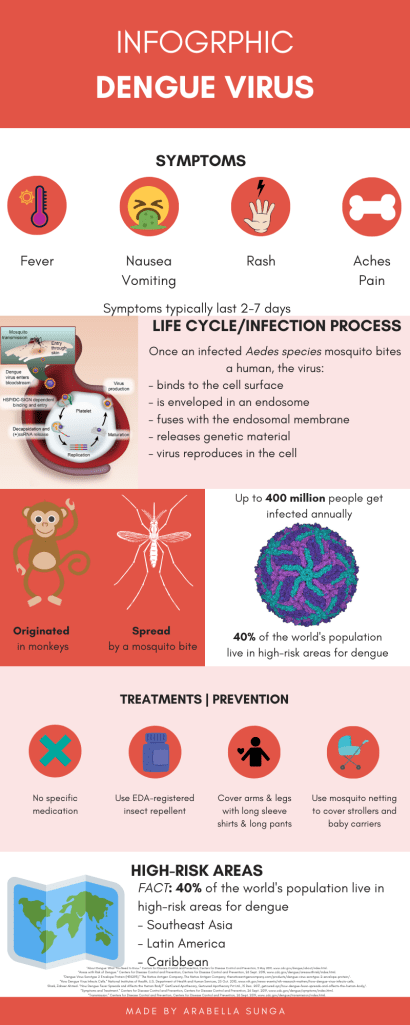
Dengue Virus Infographic

Want to learn more about Dengue virus? Check out my infographic!

Made on Canva

Works Cited

“About Dengue: What You Need to Know.” Centers for Disease Control and Prevention, Centers for Disease Control and Prevention, 3 May 2019, http://www.cdc.gov/dengue/about/index.html.

“Areas with Risk of Dengue.” Centers for Disease Control and Prevention, Centers for Disease Control and Prevention, 26 Sept. 2019, http://www.cdc.gov/dengue/areaswithrisk/index.html.

“Dengue Virus Serotype 2 Envelope Protein (HEK293).” The Native Antigen Company, The Native Antigen Company, thenativeantigencompany.com/products/dengue-virus-serotype-2-envelope-protein/.

“How Dengue Virus Infects Cells.” National Institutes of Health, U.S. Department of Health and Human Services, 25 Oct. 2010, http://www.nih.gov/news-events/nih-research-matters/how-dengue-virus-infects-cells.

Shaik, Zaheer Ahmed. “How Dengue Fever Spreads and Affects the Human Body?” GetCured Apothecary, Getcured Apothecary Pvt Ltd., 15 Dec. 2017, getcured.xyz/how-dengue-fever-spreads-and-affects-the-human-body/.

“Symptoms and Treatment.” Centers for Disease Control and Prevention, Centers for Disease Control and Prevention, 26 Sept. 2019, http://www.cdc.gov/dengue/symptoms/index.html.

“Transmission.” Centers for Disease Control and Prevention, Centers for Disease Control and Prevention, 26 Sept. 2019, http://www.cdc.gov/dengue/transmission/index.html.

Creative Commons License
This work is licensed under a Creative Commons Attribution-NonCommercial 4.0 International License.

Gene Therapy

Ahh, gene therapy reminds me of my symposium about the genetic disorder Adenosine deaminase deficiency that causes severe combined immunodeficiency (SCID). Gene therapy is a revolutionary advancement that can help treat several disorders usually caused by a single defective gene. Check out this presentation that I made with Chloe to learn about recent technological advancements and how gene therapy works:

Extracting DNA from Strawberries!

Let me ask you this question: Where can you find DNA? I bet you’re thinking that DNA is found in all living things, right? This is true, but you may not even realize that DNA is also in small things, like cells and fruits. DNA is found in all living things to grow and develop. My AP Biology teammate, Noosha, and I created a video where we extracted DNA from a strawberry! At first, we had some trouble efficiently getting the DNA, but eventually found out what went wrong. Check out what happened in our video! Overall, I really recommend doing this experiment and learning something new, especially with a buddy. I found a new experiment I can do with my little brother! If you try it out, let me know in the comments below!

Meiosis in Motion

What is meiosis? Meiosis is categorized in two stages of division. Meiosis is a type of cell division that divides a parent diploid cell and results in four reproductive, haploid cells. The four haploid cells contain half of the chromosomes of the parent cell. My AP Biology teammate, Noosha Steward, and I created a video about meiosis in plant cells. The video covers and shows each phase of meiosis and explains the process of crossing over, which is the reason for genetic variation! Learn more about meiosis and check out our video!

I enjoyed the filmmaking and editing process with my partner. I feel like me and Noosha worked really well together and developed an awesome bond through this project. I love making stop motions for videos. Although the process was time consuming and laborious, I love seeing all the hard work come to life! I learned new features in the app, Stop Motion Studio, such as the self-timer and the grid and onion skin controls. In the past, I have created stop motion clips and manually took pictures, but I have never used the timing feature, which takes a picture when you set the timer, and the onion skin control to see and change the opacity of the previous image. I am glad I learned these useful features! Overall, I loved how our video turned out and I hope you do too. Leave a comment below!

Making a stop motion video? Here are some quick tips:

  • Use a self-timer!
  • Use the grid and onion skim controls
  • Try to be in one place so the lighting does not change
  • The more pictures the better
  • Have fun and be creative!

Check out my Twitter account: @ArabellaKM

Identifying Different Pigments of Plants Using Chromatography

Purpose: The purpose of the chromatography experiment is to separate and identify individual pigments of green colored leaves and non-green colored leaves.

Background: Photosynthesis is the process by which photoautotrophs convert solar energy into sugars. Photosynthesis occurs in the chloroplasts of organisms and is usually green due to chlorophyll, which is present in all photosynthetic organisms. Pigments within plants absorb light energy to start the process of photosynthesis. Chromatography separates and identifies the pigments within plant cells on chromatography paper. The solubility of the solute and the diffusion of the solute determines the rate of migration of the pigment. The Relative Mobility Factor (Rf) is determined by the distance of the spots of pigment on the chromatography paper traveled divided by the distance the solvent traveled. The pigment can be determined by comparing the Rf factor of one pigment from the lab to Rvalues from the same pigment under constant conditions.

Hypotheses: If chromatography was conducted on a green and non-green leaf to determine the pigments, then the non-green leaf will show a larger range of colored pigments, such as anthocyanins, along with green on the chromatography paper since there are more different colored pigments and less chlorophyll present within non-green leaves rather than green leaves.

Data:

Green Leaf

PigmentGreen
Dunknown (Distance solute traveled) (cm)7.1
Dsolvent (Distance solvent traveled) (cm)7.3
Rf (Relative Mobility Factor)0.97

Non-Green Leaf

PigmentLight Red
Dunknown (Distance solute traveled) (cm)7.6
Dsolvent (Distance solvent traveled) (cm)7.9
Rf (Relative Mobility Factor)0.96

Questions:

1. What is the basic importance of chromatography?

Chromatography separates different pigments within a mixture sample on chromatography paper to identify the substances with Rf values.

2. What factors allow chromatography to happen?

Capillary action occurs when the solvent moves up the chromatography paper due to absorption of the chromatography paper, adhesion, and cohesion. The solvent is attracted to like molecules (cohesion), but is also attracted to other substances, such as the paper (adhesion). As capillary action occurs, the solute travels with the solvent. The solubility of the solute and diffusion determines the rate of which the solute travels up the chromatography paper from an area of high concentration to an area of low concentration. 

3. What purpose does the chromatography paper have in this experiment?

The chromatography paper absorbs the solvent and serves as a medium that the solute may move up on during capillary action with the solvent. As capillary action occurs, pigments may travel up along with the solvent, showing the underlying and various pigments.

4. What is the purpose of the solvent?

The solvent performs capillary action on the chromatography paper and aides the solute’s movement up the chromatography paper as the solvent moves up the paper. The solute will then show the various pigments of the leaves.

5. What does Rf value stand for?

The Rf value is the Relative Mobility Factor Value that represents a ratio of the distance a substance travels to the distance the solvent travels.

Rf=Distance solute traveled (Dunknown)/Distance solvent traveled (Dsolvent)

6. How do you think the Rf value is useful to scientists?

The Rf value helps scientists identify pigments in different leaves by comparing different pigments from leaves to standard Rf values for certain pigments since Rf values for certain pigments are constant.

7. What does Dunknown signify?

Dunknown is the distance solute traveled.

8. What does Dsolvent signify?

Dsolvent is the distance solute traveled.

9. How many pigments were you able to identify from the GREEN leaf chromatogram? Include a picture.

Only one pigment, green, was identifiable from the green leaf chromatogram and traveled at the same rate as the acetone solvent.

10. How did a GREEN leaf chromatogram compare to a NON-GREEN leaf chromatogram? Include a picture.

In this experiment, the green leaf chromatogram (right) had only had green pigments, while the non-green leaf chromatogram (left) had a light red pigment.

11. What else did you find out about pigments and photosynthesis?

Photosynthesis occurs within the chloroplast of several photosynthetic organisms, such as plants and algae. I learned that chlorophyll was the main factor that produces the green pigment within many plants. Additionally, I learned that all photosynthetic organisms contain chlorophyll in order to do photosynthesis, but some different colored plants may have smaller contents of chlorophyll.

12. What is one more question you still have?

Do carnivorous plants, such as the venus fly trap, still go through photosynthesis? If so, why do carnivorous plants need to do photosynthesis and consume insects?

The Vortex Swim Video – Plastic-Eating Bacteria

After learned about the Vortex Swim, I started to get curious about factors that help plastic deteriorate. I learned that there are microorganisms called bacteria that actually help break down plastic!

The Vortex Swim focuses on the issue of plastic pollution. To learn more about the Vortex Swim, check out my blog post: https://arabellasunga.home.blog/2019/09/03/the-vortex-swim/.

I created a video that answered this curious driving question:

How have bacteria living on plastic evolved to break down plastic over time?

Watch the video below to find the answer!